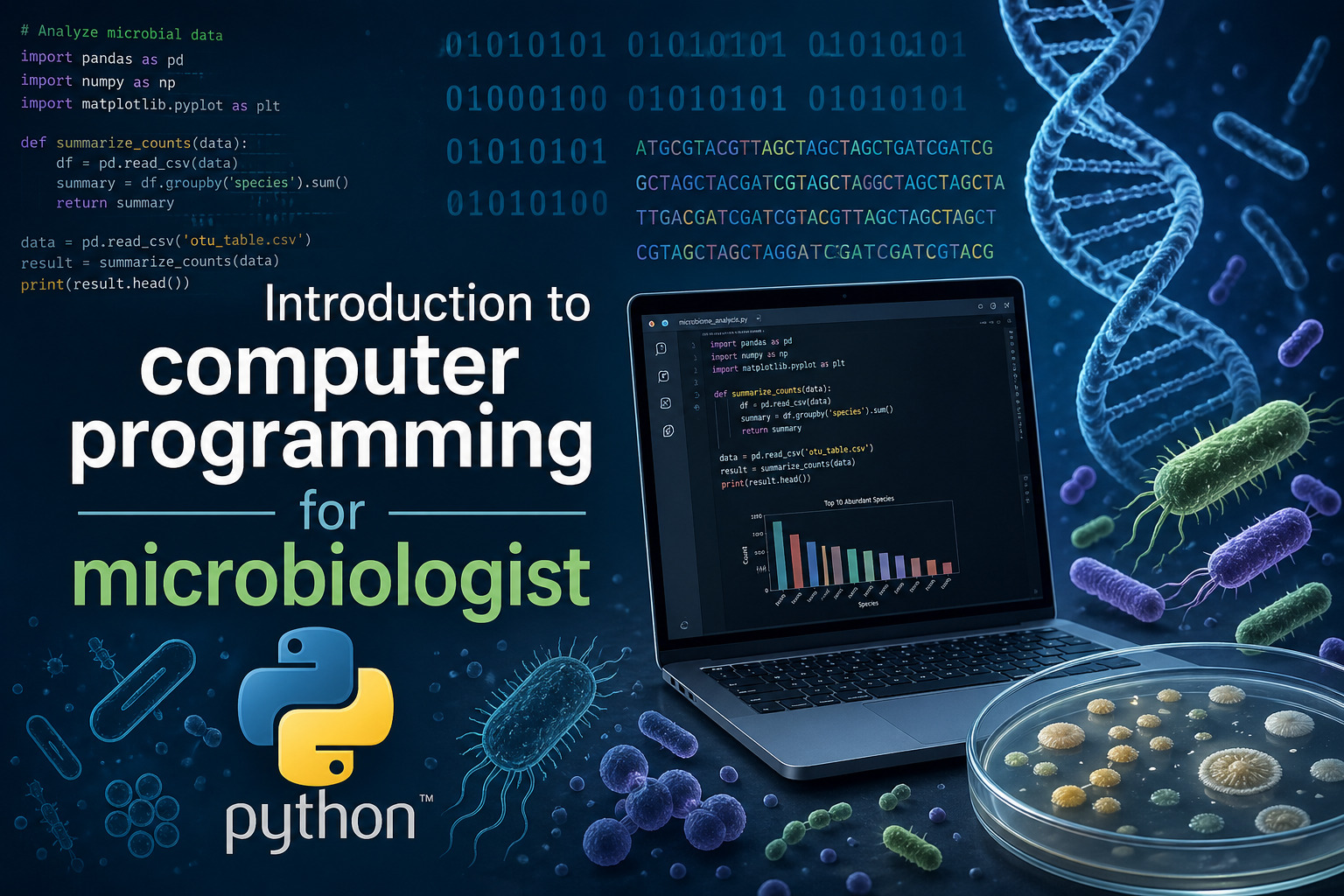
This is discovery- transversal introductory course aims to equip students with essential programming skills for scientific applications. The primary objective is to develop a solid foundation in programming concepts, enabling learners to manipulate scientific data, automate routine tasks, and use widely adopted tools such as Python and R. Students will progressively acquire the ability to apply computational approaches to real-world problems in biology, chemistry, physics, and environmental engineering. Prior familiarity with free and open-source software is recommended to facilitate learning.
The course begins with fundamental programming notions, including variables, data types, control structures, and functions, alongside good coding practices and debugging techniques. It then introduces data manipulation through advanced structures such as lists, tuples, and dictionaries, as well as file handling and the use of scientific libraries like NumPy and Pandas for data processing and visualization. The third component focuses on object-oriented programming, covering classes, inheritance, and code modularity, while also emphasizing task automation and scripting. Finally, the course highlights practical applications, including scientific data analysis, basic database concepts with SQL, and the development of small interdisciplinary projects. By the end of the course, students will be able to design, implement, and document simple yet effective computational solutions tailored to scientific contexts.
- Enseignant: selama,okba,biologie, SELAMA okba